// CASE STUDY · TORY
LIVE · ON-DEMAND
Mobile services,
on-demand.
Open the app. Drop a pin. A mobile unit is on its way.
Tory brings mobile services straight to you — to the middle of the city, to a park, to an open-air event, or anywhere a fixed solution simply doesn't exist. Instead of hunting for the nearest public option or holding out until you get home, you open an app, choose a location, and a mobile unit is dispatched.
We built the product from the ground up — a client app, a driver app, and a server-side platform that ties the two together in real time.
- apps2client · driver
- matchingAUTODispatch engine
- trackingREAL-TIMELive ETA on map
- paymentE2ESecure, in-app
// 01 · What we built
Three products. One system.
We built the entire stack from scratch — two front-line surfaces, and a server that keeps them in sync in real time.
- 01Mobile · iOS · Android
Client app
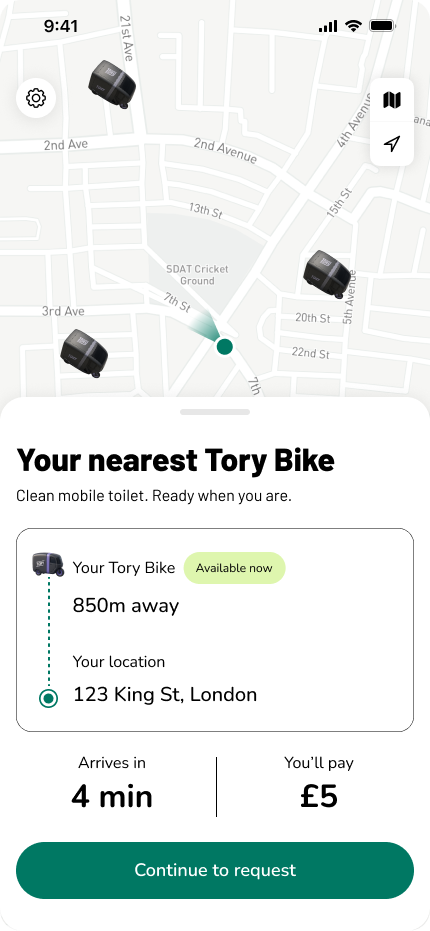
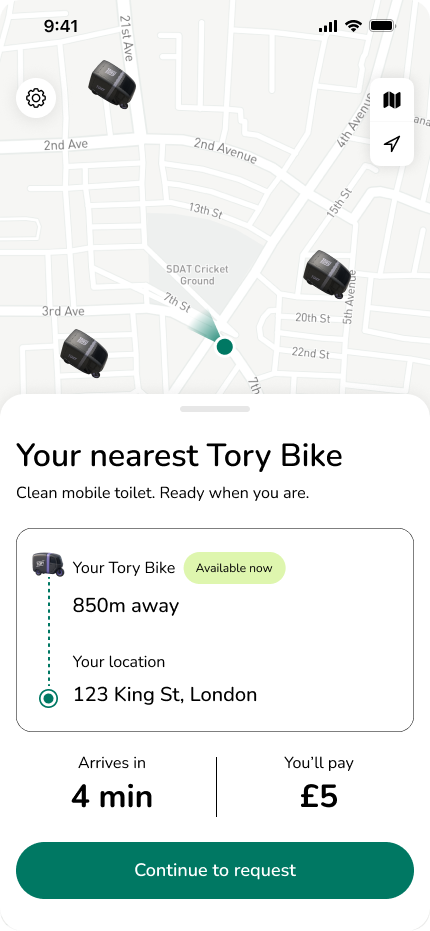
A clean surface with one goal — order a service, fast. Map, pin, confirm, track, pay. No long signup. No phone calls.
- 02Mobile · Field-grade
Driver app
A field-grade workspace for the driver: new orders, built-in navigation, and status buttons that update the customer automatically at every step.
- 03Backend · Realtime · Dispatch
Server-side platform
A dispatch engine, real-time sockets, billing, and an ops dashboard. The wire connecting customer to driver and the whole fleet to itself.
// 02 · Client app
Clean interface. Three actions.
- 01
Drop a pin on the map and confirm.
- 02
Watch the driver approach — the same experience as a ride-hailing app.
- 03
Pay inside the app. No calls, no WhatsApp threads, no figuring out who owns what.
// 03 · Driver app
A field-grade cockpit for the driver.
- 01
New orders arrive in real time with location details.
- 02
Built-in navigation — no jumping between apps.
- 03
Status buttons that update the customer automatically: en route · arrived · done.
- 04
No phone calls, no WhatsApp messages — everything stays inside the system.
// 04 · Auto-dispatch
A dispatch engine that matches by location.
The system reads the customer's location and the available drivers nearby, then routes every order to the driver who'll arrive fastest. ETAs stay short during rush hours and large events alike.
- Live geolocation
- Driver availability
- ETA optimisation
- Manual override
// 05 · Real-time tracking
The customer sees it. Ops controls it.
The same real-time backbone — two very different surfaces. For the customer: a clean ETA on the map. For ops: the entire fleet on a board, with the power to step in.
- 01
Customer view
The customer watches the driver move on the map with a precise ETA — the same model as a ride-hailing app.
- 02
Ops dashboard
Ops sees the entire fleet on the ground — who's busy, who's free, who's en route, and who's stuck.
- 03
Live intervention
When needed — move a driver, reassign an order, or solve an issue before it ever reaches the customer.
// 06 · In-app payment
Secure end-to-end payment.
No cash in the field. No credit cards handed to drivers. No invoices to chase. The order closes automatically when the service is complete, and revenue syncs straight to the dashboard.
- Mobile service£ 5.00
- Distance850m
- Arrival4 min
- Driver IDDRV-0042
// 07 · Technology
The stack behind the scenes
A modern stack chosen for the job — fast to build, stable in production, alive in real time.
- Mobile
- React Native
- Expo
- TypeScript
- Backend
- Node.js
- NestJS
- Socket.IO
- Database
- PostgreSQL
- PostGIS
- Redis
- Maps & Routing
- Google Maps
- Mapbox
- Geocoding
- Payments
- Stripe
- Tranzilla
- Cloud
- AWS
- CloudFront
- S3
- Observability
- Sentry
- Datadog
- Logflare
- Delivery
- EAS
- CI/CD
- OTA Updates
// 08 · Decisions and constraints
The decisions behind the structure
Everything described above is the result of a few product decisions made early. These are the decisions, and the constraint each one answered.
- 01
Two apps, not one
Customer and driver do completely different things: one orders and tracks, the other navigates and updates status. One screen for both would have burdened both. Hence two separate products on the same backend.
- 02
Matching happens server-side, with a manual override
An order is matched automatically by customer location and driver availability — but ops can step in: move a driver or reassign an order. Automation that cannot be overridden fails at the first event nobody planned for.
- 03
Status updates the customer, not a phone call
Three buttons for the driver — en route, arrived, done — and each tap updates the customer automatically. That is what takes phone calls and WhatsApp out of the process.
- 04
Payment closes the order
No cash in the field and no cards handed to the driver. The order closes automatically when the service ends and revenue syncs to the dashboard — so billing is part of the flow, not a separate step after it.
- 05
Location as a core data type
Matching, tracking and ETA all rely on location. So it is stored and computed in the database itself (PostGIS), not just displayed on a map — and reaches customer and ops through real-time sockets.
- 06
Updates without waiting for the store
Both apps were built with Expo and EAS, with OTA updates — so client-side fixes can reach devices without going through the store review path every time.
// 09 · What was delivered
What was delivered — and where the responsibility line runs
A good case study also says what wasn't included. This is what OneZero built and delivered in this project, with no unpublished metrics.
| Component | What was delivered | Note |
|---|---|---|
| Client app | iOS and Android: map, location pin, order confirmation, live driver tracking, in-app payment | React Native · Expo · TypeScript |
| Driver app | Real-time order intake, built-in navigation, status buttons that update the customer | React Native · Expo · TypeScript |
| Server platform | Location-based dispatch engine, real-time sockets, billing, ops dashboard with live intervention | Node.js · NestJS · Socket.IO · PostgreSQL/PostGIS · Redis |
| Payments | In-app payment and automatic order close-out when the service ends | Stripe · Tranzilla |
| Infrastructure and operations | Cloud, distribution and OTA updates, error and performance monitoring | AWS · EAS · Sentry · Datadog |
| Out of scope | This page describes the software that was built. Operating the service itself — drivers, mobile units and customer support — is not part of the project described, and the service's operating numbers are not published here. | — |
Client app
What was delivered: iOS and Android: map, location pin, order confirmation, live driver tracking, in-app payment
Note: React Native · Expo · TypeScript
Driver app
What was delivered: Real-time order intake, built-in navigation, status buttons that update the customer
Note: React Native · Expo · TypeScript
Server platform
What was delivered: Location-based dispatch engine, real-time sockets, billing, ops dashboard with live intervention
Note: Node.js · NestJS · Socket.IO · PostgreSQL/PostGIS · Redis
Payments
What was delivered: In-app payment and automatic order close-out when the service ends
Note: Stripe · Tranzilla
Infrastructure and operations
What was delivered: Cloud, distribution and OTA updates, error and performance monitoring
Note: AWS · EAS · Sentry · Datadog
Out of scope
What was delivered: This page describes the software that was built. Operating the service itself — drivers, mobile units and customer support — is not part of the project described, and the service's operating numbers are not published here.
Note: —
Planning a similar on-demand product?
This structure — a customer app, a service-side app and a real-time backend — recurs in most products of this kind. What changes is the scope: how many roles, which integrations, and what must be in the first version.
// 10 · Got a similar idea?
From the idea to an app that actually moves.
We built Tory from zero — two apps, a real-time backend, end-to-end payments. If you have an on-demand idea waiting to ship, let's talk.
On-demand. In the field. In real time.