// CASE STUDY · Onit
HEALTH-TECH · AI
A doctor's appointment
in days. Not months.
App, algorithms and data analytics — the entire product, end to end.
Onit solves a problem every insured person in Israel knows: you have health insurance, but nobody knows what it covers, how to use it or where to get an appointment soon. Onit finds an appointment within five days, translates the policy into plain language, submits the claim and tracks the refund.
onezero built the whole product: the iOS and Android apps, backend, the appointment search and matching engine, policy analysis, claims management, user-data analytics, the conversational assistant and the admin system.
- appointments booked3,824through the app
- family members18Kcovered and managed in Onit
- waiting days saved51Kversus the regular route
- average wait2days to the visit
* Figures as published by Onit on onitfast.com.
// 01 · Product overview
Your insurance.
Finally useful.
Most people pay for private health insurance and never use it — the policy is written in legal language, it is unclear which doctor is right, and the refund process is exhausting. Onit turns all of that into a single screen: search, choose, show up, and the app takes care of the money. The product was built around a few principles:
- An appointment within 5 days, not 3 months
- The policy in human language
- One-tap claim submission
- A whole family in one account
- Medical data — only for those authorized
// 02 · What we built
The entire product.
From the screen to the algorithm.
Onit came to us with a sharp insight about the market; we built the product that delivers it. Every layer — from the app in your pocket to the models analyzing the data — was written at onezero:
- 01Product definition, UX and design
- 02iOS app
- 03Android app
- 04Secure backend and API
- 05OTP login and identity verification
- 06Appointment search and matching engine
- 07Availability and distance algorithms
- 08Policy and entitlement analysis
- 09Har HaBituach connection with consent
- 10Claims and refund management
- 11User-data analytics
- 12Conversational AI assistant
- 13Voice search
- 14Family member management
- 15Operator admin system
- 16B2B2C employer model
- 17Alerts, reminders and push
- 18Security, privacy and encryption
// 03 · The challenge
Medicine, insurance and money.
In one simple screen.
Each of these domains is complex on its own. Combining them into an experience a grandmother and a student understand equally — that is the challenge:
- 01
Find a real, nearby, suitable appointment — in days, not months.
- 02
Read a policy dozens of pages long and tell the user what they are owed.
- 03
Connect to external sources like Har HaBituach — only with explicit consent.
- 04
Manage a claim from the visit to the refund, with reminders along the way.
- 05
Let a parent manage children and elderly parents from the same account.
- 06
Speak in natural language — text and voice — without getting medical topics wrong.
- 07
Learn from user data to improve matching, without compromising privacy.
- 08
Work for an employer with thousands of employees and for a single user alike.
- 09
Meet medical-data security requirements: encryption, permissions, audit.
// 04 · The solution
From the symptom
to the refund. One flow.
The journey is designed so the user does as little as possible: they say what they need — and the system finds, coordinates, reminds and files. Each step connects to the next:
- 01
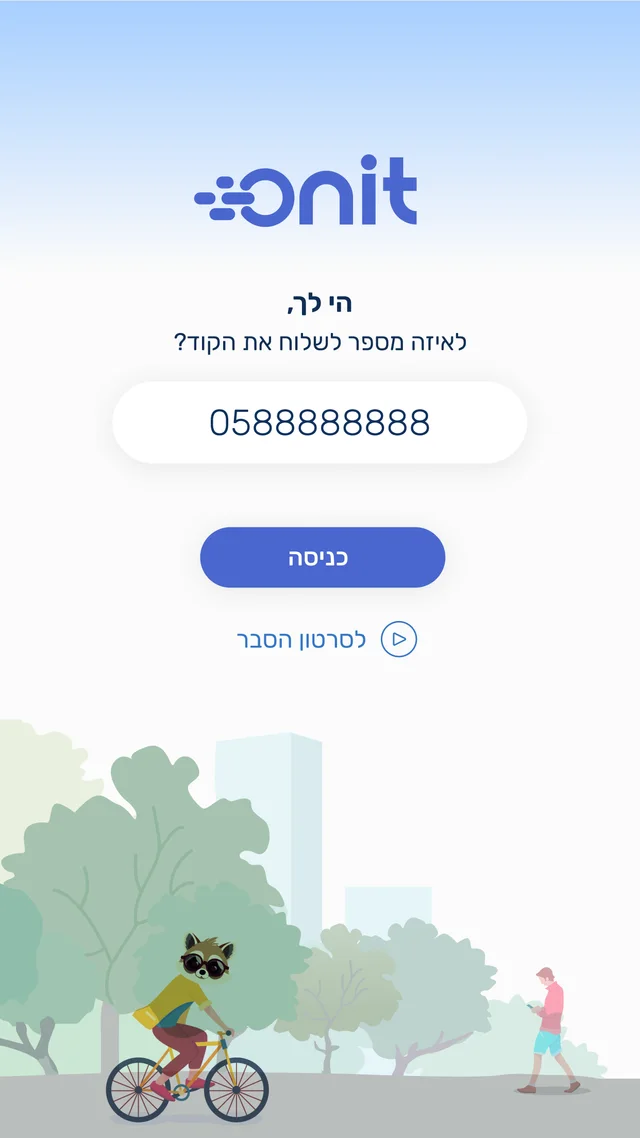
Sign in with a phone number and OTP code
- 02
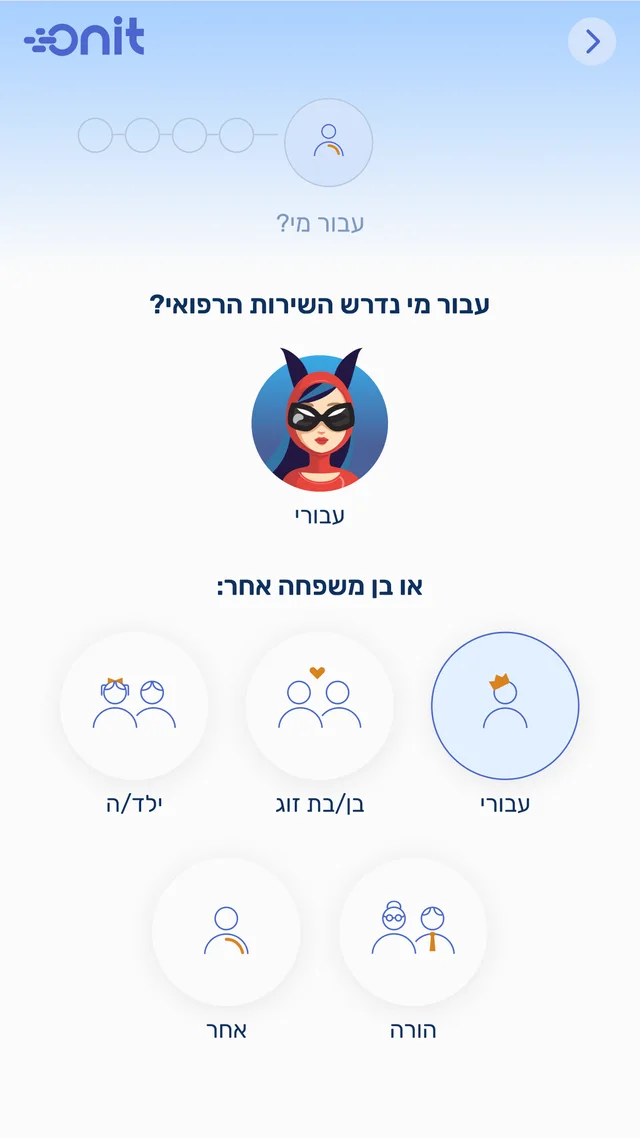
Choose who it is for — me, a child, a parent
- 03
Say what you need — tap or voice
- 04
The engine matches a doctor, clinic and open slot by policy and location
- 05
Confirm — the appointment is set within 5 days
- 06
A reminder before, a visit summary after
- 07
Submit the claim in one tap and track its status
- 08
The refund arrives — and the app lets you know
// 05 · The booking engine
Say what hurts.
Get an appointment.
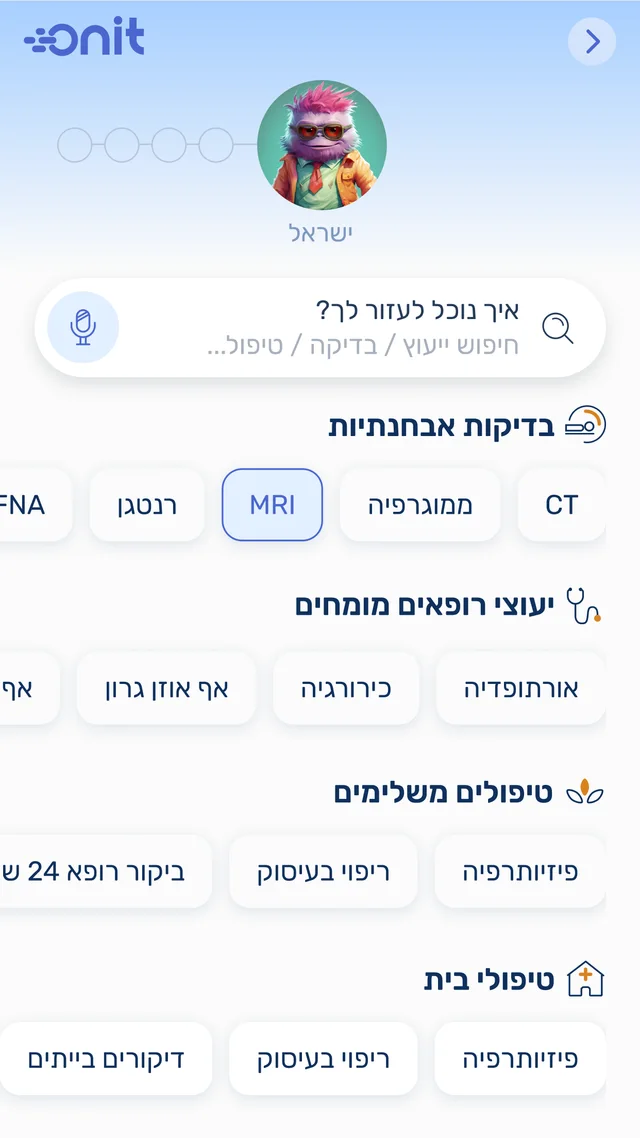
The heart of the product is a matching engine that cross-references what the user needs, what their policy covers, who is available and where. Search works by tapping a category or by speaking freely — and the result is a concrete appointment, not a list of phone numbers:
- 01Diagnostics: MRI, CT, mammography, X-ray, FNA
- 02Specialists: orthopedics, surgery, ENT and more
- 03Complementary: physiotherapy, occupational therapy
- 04Home treatments and a 24/7 doctor
- 05Natural-language voice search
- 06Ranking by availability, distance and coverage
- 07An appointment within 5 days — 2 on average
- 08Confirm, remind and reschedule from the app
// 06 · Policy analysis
Your policy.
In a language you understand.
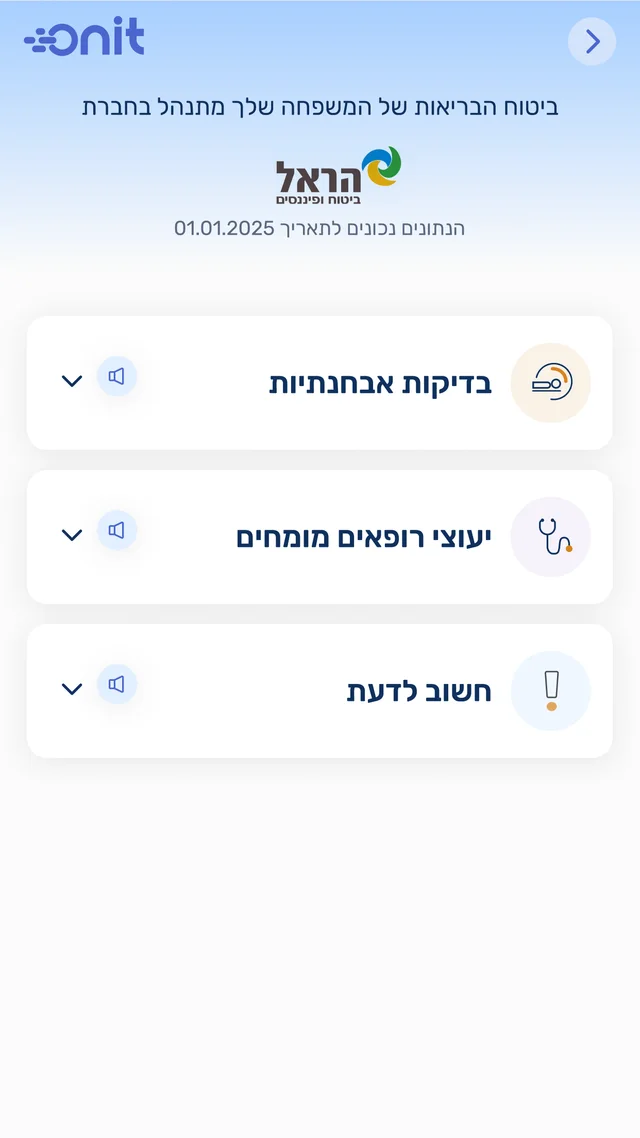
With the user's consent, Onit pulls their policies from Har HaBituach, analyzes them and produces an entitlement summary: what is covered, how much, under which terms and what is left to use. Instead of 60 pages — one clear card that updates when the insurance changes:
- 01Policy retrieval from Har HaBituach — with explicit consent
- 02Support for the leading insurers
- 03Analysis of coverage, caps and deductibles
- 04An entitlement summary in plain language
- 05Matching the appointment to existing coverage
- 06What was used and what remains — per family member
- 07Alerts on unused entitlements
- 08Questions about the policy — in conversation
// 07 · Claims & refunds
The visit is over.
The money comes back.
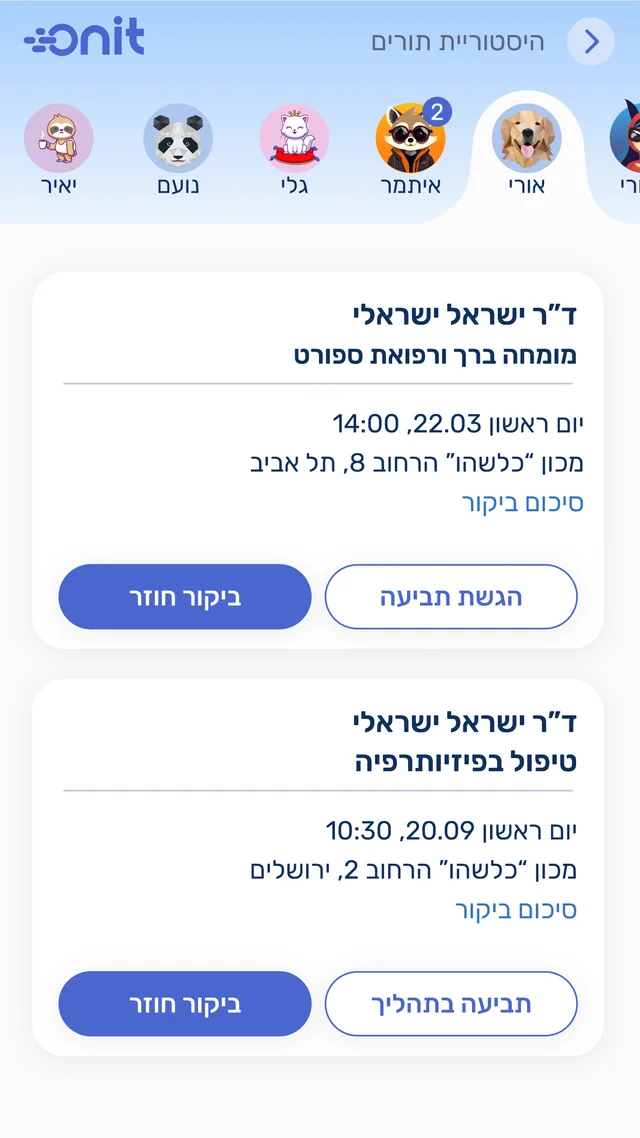
Every appointment booked automatically becomes a history record — with a visit summary, a submit-claim button and status tracking. The system knows which documents are needed, reminds the user what is missing and updates when the refund is approved:
- 01Visit history for every family member
- 02Visit summary and documents in one place
- 03One-tap claim submission
- 04Statuses: submitted, in process, approved
- 05Reminders for missing documents
- 06Upfront check: 'am I owed a refund?'
- 07Notification when the refund lands
- 08An admin interface for Onit's team to track and handle
// 08 · Family
One account.
Everyone who matters.
The person managing the family's health is usually not the patient. That is why Onit is built around 'who is this for?': in every action you pick yourself, a child, a partner or a parent — and the policy, appointments and claims are managed per person, in one place:
- 01Up to 6 family members per account
- 02Children, partners and elderly parents
- 03A policy and entitlements per person
- 04Appointments and claims kept separate and organized
- 05Permissions: who sees what
- 06Invite and add in seconds
// 09 · Conversational AI
Your insurance.
Now in a conversation.
Instead of navigating menus, the user simply asks: 'am I covered for physiotherapy?', 'find me an orthopedist this week'. The conversational assistant understands the intent, pulls the answer from the policy and the engine, and replies in plain Hebrew — or performs the action. It is deliberately limited to policy and system data and does not invent medical answers:
- Intent understanding in natural Hebrew
- Answers grounded in the policy only
- Actions: search, book, claim
- Voice search
- Guardrails for medical topics
- Hand-off to a human when needed
- Learning from conversations to improve matching
- Full log for oversight and quality
// 10 · Data & analytics
Every appointment teaches
the system something.
Onit is a product that improves with use. We built a data layer that analyzes user behavior — what people search for, what they confirm, how long they wait, where claims get stuck — and feeds the insights back into the matching engine, the product and the dashboards for Onit and employers. All on aggregated, encrypted data:
- 01Wait metrics: days saved, time to visit
- 02Demand by field, region and hour
- 03Confirmation and claim-completion rates
- 04Bottleneck detection in the flow
- 05Improving ranking in the matching engine
- 06Employer dashboards — aggregated, de-identified
- 07Quality monitoring for the assistant
- 08In-app events and funnels
- 09Full separation between medical data and analytics
- 10Investor and partner reporting
// 11 · Employers & plans
An employee benefit
people actually use.
Onit is also sold as an employer benefit: the company buys a plan, employees and their families get the service. The system supports organizations, enrollment codes and multiple plans — and gives the employer an aggregated usage picture without exposing personal medical data:
- Plans: Free · Basic · Plus · Infinity
- Organization and employee management
- Enrollment codes and permissions
- Employer usage dashboard
- Billing and subscription periods
- Clients: Wiz, Playtika, Ackerstein and more
- Onboarding for new employees
- Admin interface for Onit's team
// 12 · Security & privacy
Medical data.
Only for those authorized.
The product touches the most sensitive data there is: health, insurance and money. So security is not a layer — it is the architecture. Only the user and those they authorize can see medical data, all communication is encrypted and every access is logged:
- 01OTP authentication and device binding
- 02Encryption in transit and at rest
- 03Family-member-level permissions
- 04Explicit consent for every external connection
- 05Audit log for every data access
- 06Separation of medical data from analytics
- 07Account and data deletion on request
- 08Rate limiting and abuse protection
- 09Managed secrets and keys
- 10Monitoring, alerts and backups
// 13 · The apps
iOS and Android.
One product, one language.
Onit is available on the App Store and Google Play, fully in Hebrew and right-to-left. The app is built for a wide audience — from young parents to elderly parents — so the emphasis is on large screens, few decisions per step, voice as an alternative to typing, and notifications that bring the user back exactly when needed:
- 01App Store and Google Play
- 02Full Hebrew, proper RTL
- 034.8 rating on the App Store
- 04Smart push notifications
- 05Voice search
- 06Document and receipt upload
- 07Accessibility and text scaling
- 08Continuous updates — version 1.30+
// 14 · The outcome
Thousands of appointments.
Tens of thousands of waiting days saved.
Onit lives in the pockets of tens of thousands of family members, is sold as a benefit to companies like Wiz, Playtika and Ackerstein, and has already booked thousands of appointments at an average two-day wait — by its own published numbers. Behind every one of those appointments is the product we built: the app, the matching engine, the policy analysis, claims management and the data that improves all of them.
The infrastructure is built to keep growing: more medical fields, more insurers, more employers — and more AI capabilities, without a rebuild.
// 15 · Technology & capabilities
What's under the hood
Every layer was built for a real health product: secure, precise, scalable and learning.
- MOBILEiOS and Android apps
- APISecure backend and API
- MATCHINGAppointment search and matching engine
- ALGOAvailability, distance and coverage algorithms
- POLICYPolicy and entitlement analysis
- INTEGRATIONHar HaBituach integration
- CLAIMSClaims and refund management
- DATAUser-data analytics
- AIConversational AI with guardrails
- VOICEVoice search
- SECURITYOTP, permissions and encryption
- FAMILYFamily profiles
- B2BB2B2C: organizations and plans
- ADMINOperator admin system
- NOTIFYPush, reminders and alerts
- OPSMonitoring, audit and continuous delivery
// 16 · Building a health or AI product?
When the product needs
a brain, not just a screen.
onezero builds products where the app is only the tip: behind it are algorithms, data, integrations and security doing the real work. If you have an idea that needs every layer — let's talk.
App, algorithm and data. One product.